My son failed his GCSE maths by one mark.
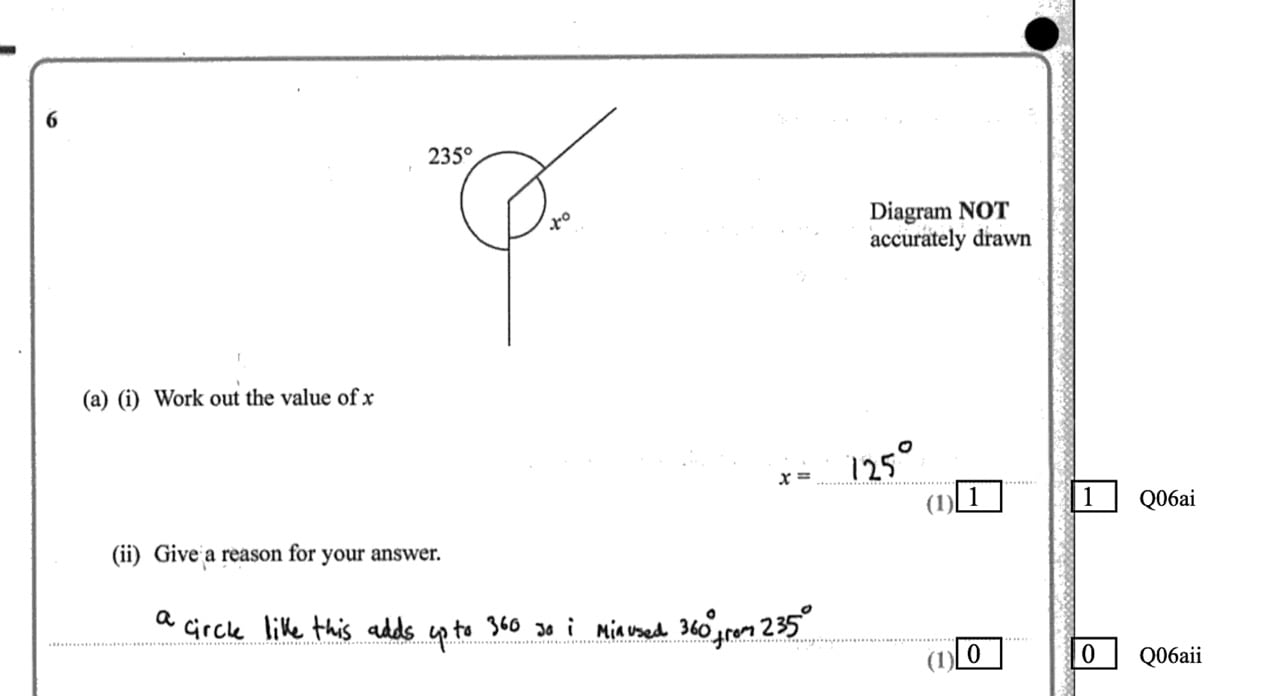
This question is one of the reasons why.
He understood the mathematical process. He knew there are 360 degrees in a circle. But his severely dyslexic brain mixed up answer A and answer B in the explanation.
That one processing error cost him the mark.
And that one mark cost him the pass.
Sometimes a question does not reveal what a young person knows. It reveals how easily they can navigate the wording under pressure.
When the wording becomes the barrier
If the question had simply asked what it needed to know, then followed with, “How many degrees are there in a circle?” and “How do you use that to find the answer?”, my son could have shown his understanding.
He did understand the maths.
What he struggled with was not the concept. It was the way the question was structured, sequenced and presented under exam conditions.
This is why exam accessibility matters.
Some questions do not just test knowledge. They also test working memory, sequencing, language processing and the ability to untangle wording under pressure.
For dyslexic, autistic, ADHD and SEND learners, that can turn an exam paper into an obstacle course.
This is not about making exams easier
Fairer Exams is not asking for lower standards.
We are asking for exam questions to measure what they are meant to measure.
If a maths question is testing whether a young person understands angles in a circle, then the question should allow them to demonstrate that understanding clearly.
It should not unnecessarily punish a learner because their brain processes language, sequencing or multiple-choice explanations differently.
Do not assume that a rejection from one course or provider means that every route is closed. Other courses, colleges, apprenticeships or progression pathways may have different entry requirements.
A fair question should test the skill it is meant to test — not create extra barriers that have nothing to do with the subject.
What Fairer Exams is asking for
Fairer Exams is calling for all GCSE and Functional Skills English and maths papers to be reviewed before publication by independent specialists in:
- dyslexia
- autism
- ADHD
- SEND
- accessible assessment design
These reviews should happen before exam papers reach pupils, not after young people have already lost marks, confidence and opportunities.
This is not about removing challenge.
It is about removing unnecessary barriers.
Fairer exams means fairer questions too.
Struggling with the format of an exam is not the same as lacking English skills.
Help us campaign for fairer exams
Too many young people are being judged by assessment formats that do not allow them to show what they really understand.
Sign the Fairer Exams petition to support our call for fairer GCSE English and maths assessment.
You can also watch the TEDx talk to hear the story behind the campaign and why change is needed.